A Fresh Start

I wanted to start the month off right by finishing a project that’s been on my to-do list for way too long. Now granted, I have plenty of unfinished projects, but this one was for my grandmother.

Back in July, she requested that I make her a shrug. Of course I said yes. This is the woman that supplies me with really beautiful homemade quilts. I couldn’t say no to her. Plus, I really do like sharing something that I made with her since she has been making things for me since I could remember.

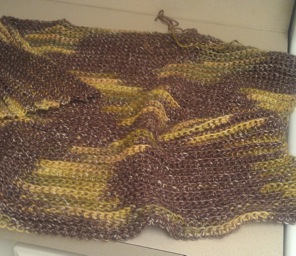
We searched around on Ravelry and came up with this pattern for the Sequoia Shrug (Ravelry link). She picked a very pretty yarn from my stash and I started on it right away. What I didn’t realize at the time was that to get the ribbed pattern that was shown, you would be crocheting this entire thing through the back loop. That slowed me down quite a bit. Crocheting through the back loop is easy but not as quick as just a regular crochet stitch.
IMAG0324-2011-11-1-00-29.jpg

Every few weeks, I would see this project in the apartment and pick it up out of guilt to add a few more stitches. Finally, in the process of preparing for Nanowrimo and Nablopomo, I decided to bite the bullet and get it done. I’m happy to have my first post of Nablopomo be a celebration of finishing. Maybe I will even write a crocheter into my Nano novel. ummm. I really haven’t planned that through so that will be another post for later. For now, I am happy to be packing this up to ship to grandma. This is a great project for new and seasoned crocheters alike and the finishing is minimum so that is great. You are pretty much just crocheting a big rectangle and then stitching to get the shape.
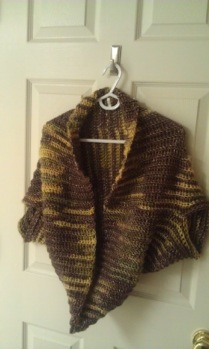
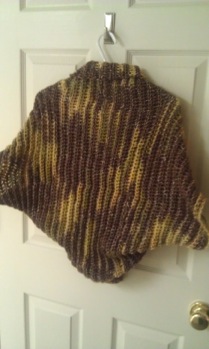
IMAG0329-2011-11-1-00-29.jpg IMAG0328-2011-11-1-00-29.jpg

Sorry I don’t have any model shots for you. I’ve never really liked the look of shrugs on my body type.
My Try Again Twist-Out


IMAG0302-2011-10-30-12-41.jpg

I am finally getting to the point where I can have a decent twist-out. When I was transitioning, I was so excited about cutting off my relaxed ends so I could do one of those pretty twist-outs I always saw everyone on YouTube doing. I went natural in September of 2010 and I did my BC in February of 2011. And I tried the twist-out only to have it fail. One of the problems is that the shorter your hair, the smaller the twists need to be. But that I could deal with. What I couldn’t deal with were the ends of my hair that still seemed to be straight. Originally, I attributed this to the heat I had used while transitioning so I decided I would table the twist-out issue until my hair was longer and I could get a trim without sacrificing so much length. I didn’t have much at that point to work with.

At least that was the original thought. It wasn’t long before I took some scissors to the top part of my head hoping to do away with the strightees. No luck. The top of my head grows hair that is much looser in curl, so loose that some of it will not lock in when setting a twist. The ends just kind stick out and threaten to unravel at any moment. No amount gel keeps it locked.

So, fast forward a few months. I have some length now and I’m still determined to get a good twist-out. The flat twist has become my setting style of choice because of my looser curls, but I do love the look of the twist-out. Recently I met Chai of Back to Curly and immediately fell in love with her twist out. Her hair is much, much longer than mine, but it inspired me to give it another try. So, I did.

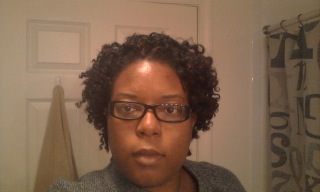
I started with freshly washed hair and set it using a cheap but good styling creme (more on products in future posts). I used smallish twists to discourage the unraveling, but let me show you what I ended up with.IMAG0282copy-2011-10-30-12-41.jpg IMAG0284copy-2011-10-30-12-41.jpg IMAG0288-2011-10-30-12-41.jpg

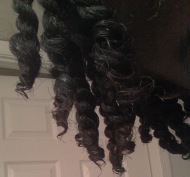
The twists on one side of my head curl on to themselves perfectly, giving me a nice little spiral action at the end of each twist. The other side has twists that seem to be barely hanging together and just loosely stick. But my determination won out and I ended up with a very pretty twist-out. As you can see from the first picture, I styled it the first day with my top pinned back to mask my straighter ends. I was afraid they would become a frizzy mess by the end of the day.

That night, I reset my twists dry and put a little styling creme on the ends to seal them up. This is the day 2 hair.

IMAG0309-2011-10-30-12-41.jpg

It was cute, but not exactly what I wanted. That night (last night actually), I reset them by spraying a little water/conditioner mix on the hair and then sealing the ends with the styling creme. Much better results.

IMAG0315-2011-10-30-12-41.jpg

So, thank you Chai for the inspiration to try again. The twist- out and I have now made peace and although I still have a looser curl pattern in the top to contend with, I am loving the results. Natural hair is all about trial and error. You can’t give up. Sometimes you just need to walk away and try again later.

Why You Should Use Twitter At Your Next Conference

Prior to the Blogalicious 2011 conference, I had not used Twitter since February 2010! Since I love technology, I had kept up with the Twitter news and I know how Twitter was being used for news sharing and celebrity misconduct, but Twitter’s practicality in my life had shown itself to be rather limited. Enter the world of Blogalicious and everything changed. At the start of the conference we were given the hash tag established for the event (#blogalicious11).

I ignored the request for a little while until someone at my table started commenting about something she had just read in the twitter feed. It piqued my interest enough that I thought I should at least give it a glance. Lucky for me, my computer remembered my twitter handle and password. And then I remembered one of the reasons I am not a big twitter user. The twitter website is not the most usable site out there. So, I downloaded Tweetdeck, set up a column to follow the conference has tag and I was on my way.

It wasn’t long before I started to see the value of using twitter during this conference.

        ❑        Build Enthusiasm. Past conference attendees were tweeting about how excited they were to see each other again. New attendees were tweeting about what they were hoping to learn. Some were tweeting of their anticipation as they waited to get off the plane or waiting for the taxi to at least move another five feet so they could feel they were getting closer. Everyone was buzzing and the buzz was contagious.

        ❑        Run Contests. Want to give away copies of your book, a cell phone, a new line of products? Encourage attendees to use your own hashtag and gain much needed buzz among conference attendees and the twitter-verse at large. Win, win all around.

        ❑        Get content from sessions you were not able to attend. What do you do when the session on writing a great pitch is held at the same time as the session on creating kick-ass content? Just pick one and use the tweet stream to gain information from the session you couldn’t attend. You don’t get the full impact but you definitely don’t loose out completely.

        ❑        Share notes. In sessions where so much information is flowing, it is easy to miss something. Wait a few seconds and someone in the room will tweet what you missed. No need to interrupt the presenters asking them to repeat content. The Twitter-verse has you covered.

        ❑        Virtual Lost & Found. We all loose things. It’s inevitable. What better way to let technologically savvy people know they lost something than through a tweet? But that goes the other way as well. I remember seeing tweets from an attendee that managed to hold on to her computer but not her cell phone. A few tweets and she was soon reunited with her lost lifeline.

        ❑        Make contacts. With 300+ attendees, there was no way to make rounds and meet everyone. Did I mention that I’m actually quite a shy person. While it is not common for me to walk up to a stranger and say hello, I was comfortable responding to someone’s tweet and letting that serve as the introduction that would push me into making a real life contact. Don’t forget, everyone attending these conferences are not as outgoing as you would think.

        ❑        Organize side gatherings. Cocktails, impromptu book signings, swag swaps, etc. There were so many things going on, no one could ever get bored or lonely at this conference.

How do you use Twitter at your conferences? Do you find it useful or a distraction?